
The University of British Columbia Okanagan's students are long-used to finding themselves in the throes of idiosyncrasy. This university is one of great renown and prestige thanks to its name, yet it is often ignored by its Vancouver campus which grants it that renown.
Perhaps the greatest idiosyncrasy of all is that UBC has a reputation as being the pre-eminent rich kid's school in the province. That reputation may be well-earned in Vancouver, yet the population of UBCO is not made up of cosmopolitan 20-somethings so much as a messy array of international students, engineers from the prairies, and a hodgepodge of everything else which helps to create a deeply distinct campus. Not exclusive to this campus, however, are the dual crises of affordability and austerity.
As the BC provincial government prepares to receive a review on its post-secondary education priorities and policies, it has been made overtly clear that practically nothing is off the table in terms of cost saving measures. Premier David Eby's NDP government has motioned that in order to address the province's $11 billion budget deficit, they are looking to cut as much of the fat as possible to minimize the damage.
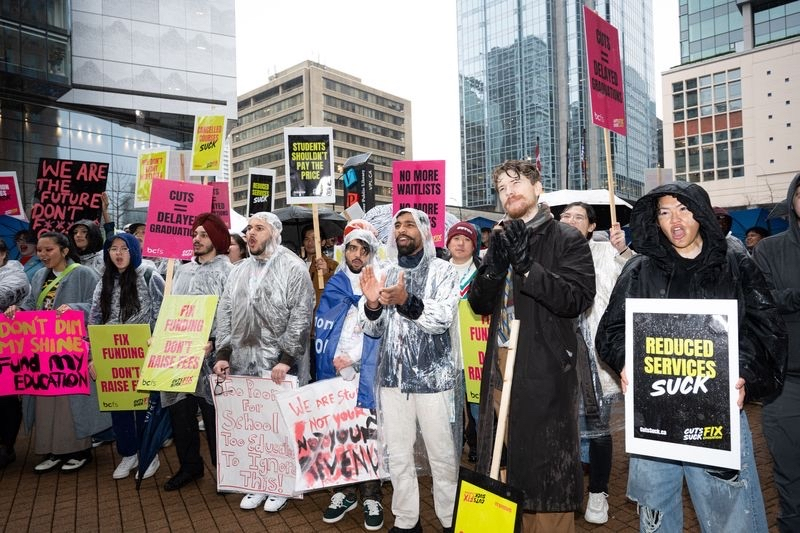
While they have promised not to touch education and other similar services, there is the aforementioned ongoing review of post-secondary education which will likely do exactly that, including the possibility of a rather alarming change: tuition increases per-year are currently capped at 2% per year, but if the review finds the cap to be unnecessary, then tuition could increase by however much the province finds to be necessary. Evidently, for many student organizers and the average student, this would be an unwelcome change, and so it is in that spirit that the British Columbia Federation of Students (BCFS) met in Richmond at the beginning of February for its annual general meeting (AGM).
I attended that AGM as a delegate for the SUO, invited to observe the inner workings of the BCFS and follow what actions our union is taking to oppose the upcoming review and to help solidify our various locals into a cohesive movement. In practical terms, this has meant electing four directors-at-large, a chair, a secretary-treasurer, and an Indigenous caucus chair, establishing new demands and goals in pushing the government to support actions like a rent freeze and further measures to construct affordable housing, and demanding the government neither raise nor remove the 2% tuition cap.
What was much more informative, however, were the individual conversations I had with union representatives from across the province: be it their deeply experienced staff who have served with unions for decades or newly-elected nurses serving as faculty representatives, it made for a unique environment of people from across the province. Given that environment, I spoke with various figures in the BCFS, and what was most striking was the fact that Local 12 (that is, our SUO) and most of the BCFS were members of merely a provincial union rather than a national or international union —- surely banding together with more unions would provide more leverage to push back against the provincial government's possible removal of the tuition caps?
What I found out from the more experienced members present at the AGM was as follows: while the BCFS has stood as an alliance of BC-based students' unions, the BCFS' own experience with national organizations has always been more prickly, to say the least. Case in point, the BCFS and all BC-based students' unions in the nationwide Canadian Federation of Students (CFS) were expelled outright in 2018 over a litany of complaints, including local campuses not being permitted to host referendums to leave the CFS, various breaches of CFS bylaws, and other similar complaints.,
The BCFS has since stabilized, currently playing host to at least 14 campuses across the province, also having added a prospective new local at this year's AGM (the Northern Undergraduate Student Society). Given that context, a new conversation arising among many union locals is on the topic of the Canadian Alliance of Student Associations (CASA), a national students' union which seems to be challenging the position of the CFS.
While most BCFS members are not also members of CASA, some (like the Camosun College Student Association) maintain membership with both organizations. Nevertheless, as the future of post-secondary education as a whole remains deeply uncertain in the face of the imminent provincial review, every student of UBCO is finding itself bracing for impact, as is the BCFS.



.png)

