

British Columbia has played host to a wide realm of political controversies over the course of the past decade. Pipeline protests, logging camp showdowns, and pro-Palestinian campus encampments have all seen concerted and sustained confrontations between local activist groups seeking to remain entrenched in a given locale, and the RCMP’s Community-Industry Response Group (C-IRG), an organization functioning not unlike a paramilitary group specifically dedicated to counter protestors of all kinds.
Established in the aftermath of the Standing Rock standoff in the United States between 2016 and 2017, and in the context of years of escalatory anti-pipeline protests and encampments, the RCMP took it upon itself to establish a unit dedicated specifically to disgorging activists established in defences and encampments.
Tasked with clearing blockades in BC, particularly through the Wet'suwet'en-led blockades in Northern BC and the Fairy Creek blockades on Vancouver Island from 2019-onwards, along with a number of other engagements since., The C-IRG has earned 572 complaints since its establishment, ranging from abuse of authority to excessive force, prompting a systemic investigation into its operations.
That investigation continues presently, as while a final report has been certified, it cannot be released until the Civilian Review and Complaints Commission for the RCMP (CRCC)’s chair approves it. The issue is that the CRCC has not had a chair since January 2025, which is necessary for the basic functioning of the Commission. Accordingly, while the several years’ worth of reports of RCMP (and C-IRG) misconduct has theoretically been completed with recommendations filed, the report of progress on institutional reform has been de-facto blocked since the final months of the Trudeau government.
Now, with a stonewalled federal investigation, the controversial RCMP group has recently been spotted on-campus by students, and questions are beginning to swirl as to why it might be here.
“I was walking from EME to the bottom entrance of the Commons when I noticed a uniformed RCMP officer step out of his unmarked truck and make his way towards the security administration entrance,” said Jake Yule, a student on campus. “I took notice of the patch on his vest which said RCMP [CRU].”
Mr. Yule found the logo vaguely familiar, and following cursory research of his own, he found that it was a rebranded rendition of the RCMP’s C-IRG. Identifying himself as a Canadian citizen and veteran, Mr. Yule stated that the presence of the officers made him feel uneasy by virtue of his knowledge of their prior actions.
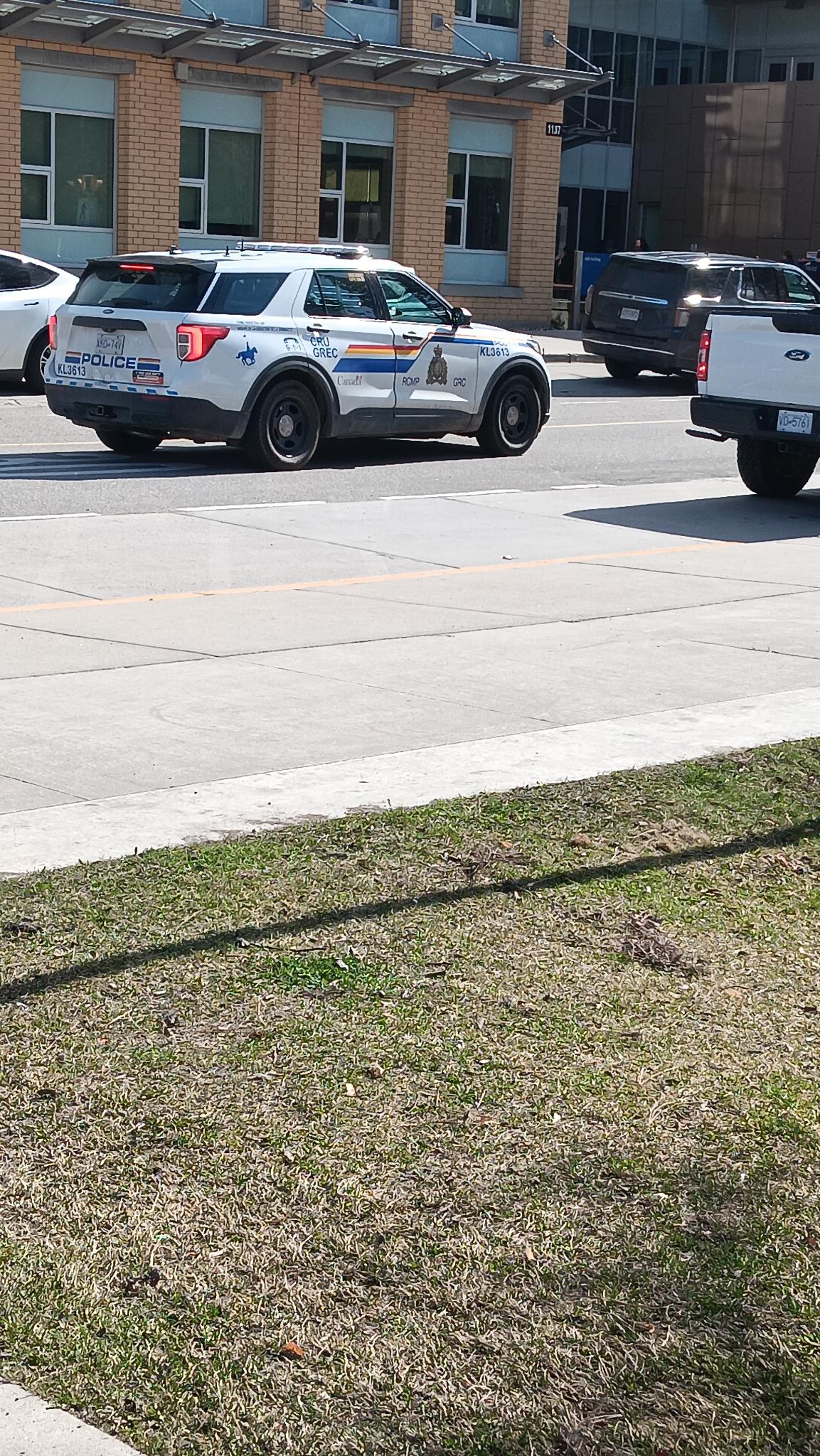
“I still felt pretty intimidated by this action. Therefore, I can not even begin to imagine how this scenario might have similarly affected my fellow colleagues who do not enjoy the same privileges that I do.”
Evidently, seeking to overcome that reputation, the C-IRG changed its name to the “Critical Response Unit - British Columbia” (CRU-BC), and expanded its mandate with the cooperation of the provincial and federal governments. Since its rebranding on January 1st, 2024, the CRU-BC has been tasked with intelligence-gathering operations for the provincial government’s secretive “Critical Incident Secretariat” and the “Civil Disobedience/Public Order” groups.
This rebranding and further integration into the provincial government’s response plan to protests and demonstrations was seemingly first planned after the public relations disaster that was the Fairy Creek blockade, which resulted in 1,188 arrests at its peak in 2021, making it the largest act of civil disobedience in Canadian history.,
Since the formal 2024 rebranding, the CRU-BC has been heavily involved in the clearing of campus encampments across B.C., not only in the act of evicting activists, but also in advising campus administrators on how to punish those students with anything from expulsion to criminal charges.
UBCO is not the first campus to take clear note of the presence of the CRU-BC on its campus beyond the campus encampments of 2023-2024, as UBC-Vancouver has recently seen. By virtue of a freedom of information request filed by Breach Media, it has become known as recently as March 2026 that the then-C-IRG was actively monitoring the UBC-Vancouver campus encampment of 2024 as soon as it became active.
In the meantime, the increased presence of the CRU-BC has only raised further concerns, as the RBC Off-Campus movement at UBCO continues to operate legally, though perhaps with renewed consternation. When reached for comment, RBC Off Campus provided the following quote: “It is shameful that UBC has repeatedly welcomed the RCMP onto campus under the guise of ‘security’ and ‘community safety’. Cops don’t make us safe. Normalizing police presence is dangerous. we know that the CRU branch of the RCMP has collaborated with universities to suppress life-affirming, anti-genocide student protest for Palestine. We know that they violated Indigenous Land Defenders’ charter rights. Cops off campus means more safety for everyone.”


.png)

