
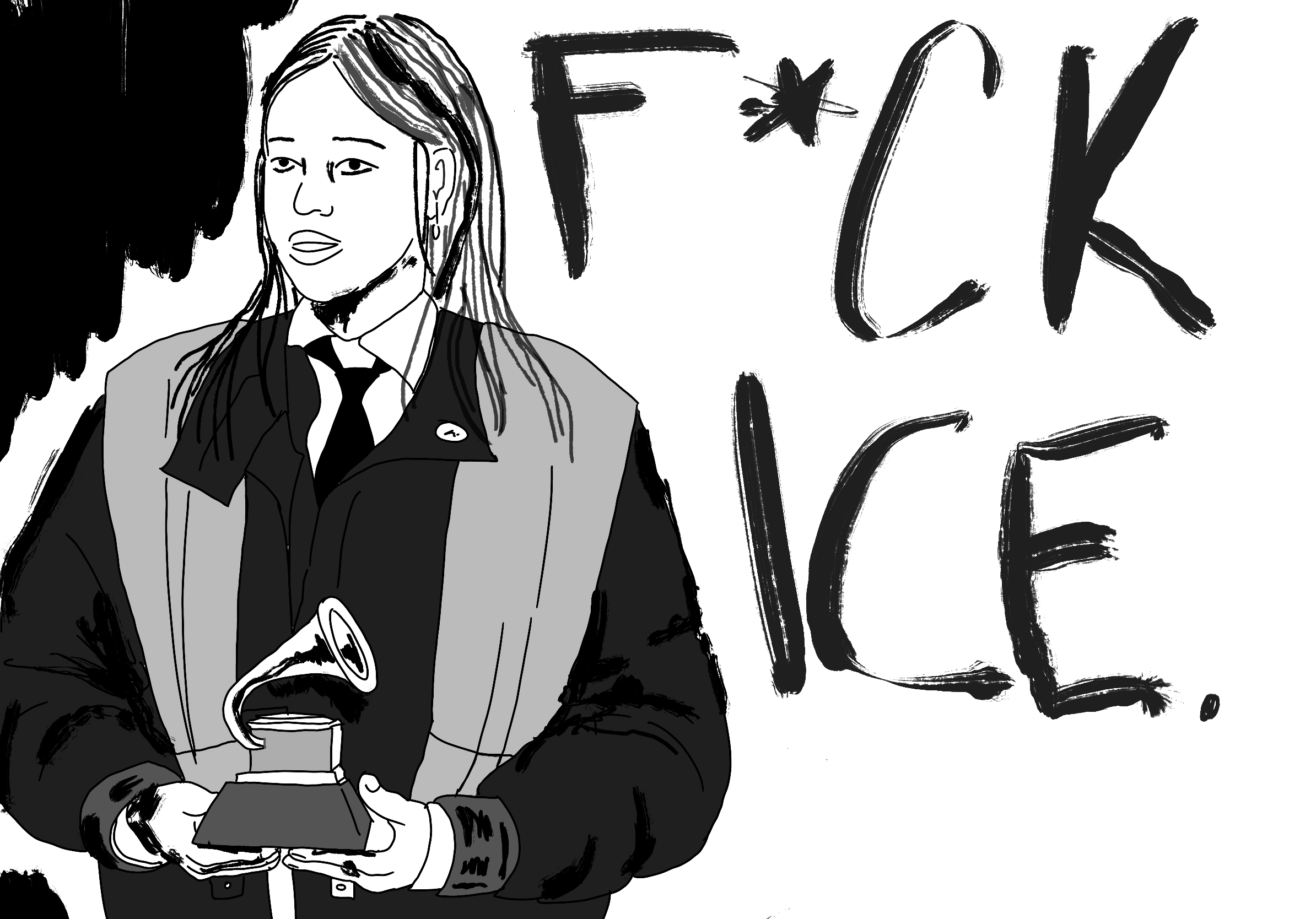
I love award shows, but not for the corny jokes, snubs, or monologues. I love the political and cultural discourse they generate. My favorite part of award shows is the nostalgia of fighting bedtime as a child to watch them, and then growing up and realizing which moments became definitive pillars of pop culture history.
At the 68th Grammy Awards on February 1, 2026, in Los Angeles, “ICE out” was a major part of the conversation. NPR explains that this protest was organized by the group 50501, which called for a national day of action and encouraged boycotts of corporations believed to support ICE. “ICE out” calls for the removal of U.S. Immigration and Customs Enforcement agents and challenges the role of federal immigration enforcement more broadly. Artists like Billie Eilish, Justin and Hailey Bieber, Kehlani, Joni Mitchell, and Bad Bunny, among many others, have chosen to speak out either physically or verbally.
But this is nothing new. Award shows, especially the Grammys, have always been a space for political statements.
In 2014, Macklemore and Ryan Lewis performed Same Love alongside Mary Lambert and Trombone Shorty. The performance ended with Queen Latifah marrying 33 couples on stage, a moment that came as the country moved toward Obergefell v. Hodges, which legalized same-sex marriage across the United States.
In 2015, Pharrell Williams’s performance of Happy included a tribute to Michael Brown, with background performers dressed in black hoodies and raising their hands in the “hands up, don’t shoot” gesture.
In 2016, Kendrick Lamar delivered a politically charged performance of Alright, using jail imagery and pointed lyrics to highlight racial violence and systemic injustice, including a reference to Trayvon Martin.
Even earlier, in the early 2000s, The Chicks publicly denounced the war in Iraq, and a few years later Bruce Springsteen called on George W. Bush to “bring ’em home” in reference to U.S. troops still deployed overseas.
So the real question is, do you care about the engaging spectacle of a performance more than its nuance? Do you expect your favorite artists to use these moments to say something meaningful about the world we are living in?
Personally, I understand watching award shows purely for entertainment. Television has always been a form of escape, a way to step away from the harsh realities of the world. Not everyone wants politics bleeding into everything, especially during something meant to be celebratory. There is a reason why we all collectively skip the “COVID season” of our favorite shows. Sometimes we just want the fantasy of oblivion.
At the same time, I also subscribe to the idea that everything is political. Art does not exist in a vacuum. Politics, policy, and the current administration set the conditions that shape pop culture, even when artists are pushing back against them. We are all extensions of communities that are impacted by these decisions in real ways. So when a celebrity, whether they belong to that community or stand as an ally, shows support through a pin, a speech, or a performance, it can matter more than we realize.
Award shows are not frozen in time. They are reflections of the political and cultural moment we are living in. If we care enough to consume the art these artists pour their blood, sweat, and tears into, then we should also care enough to listen when they choose to speak.


.png)

