
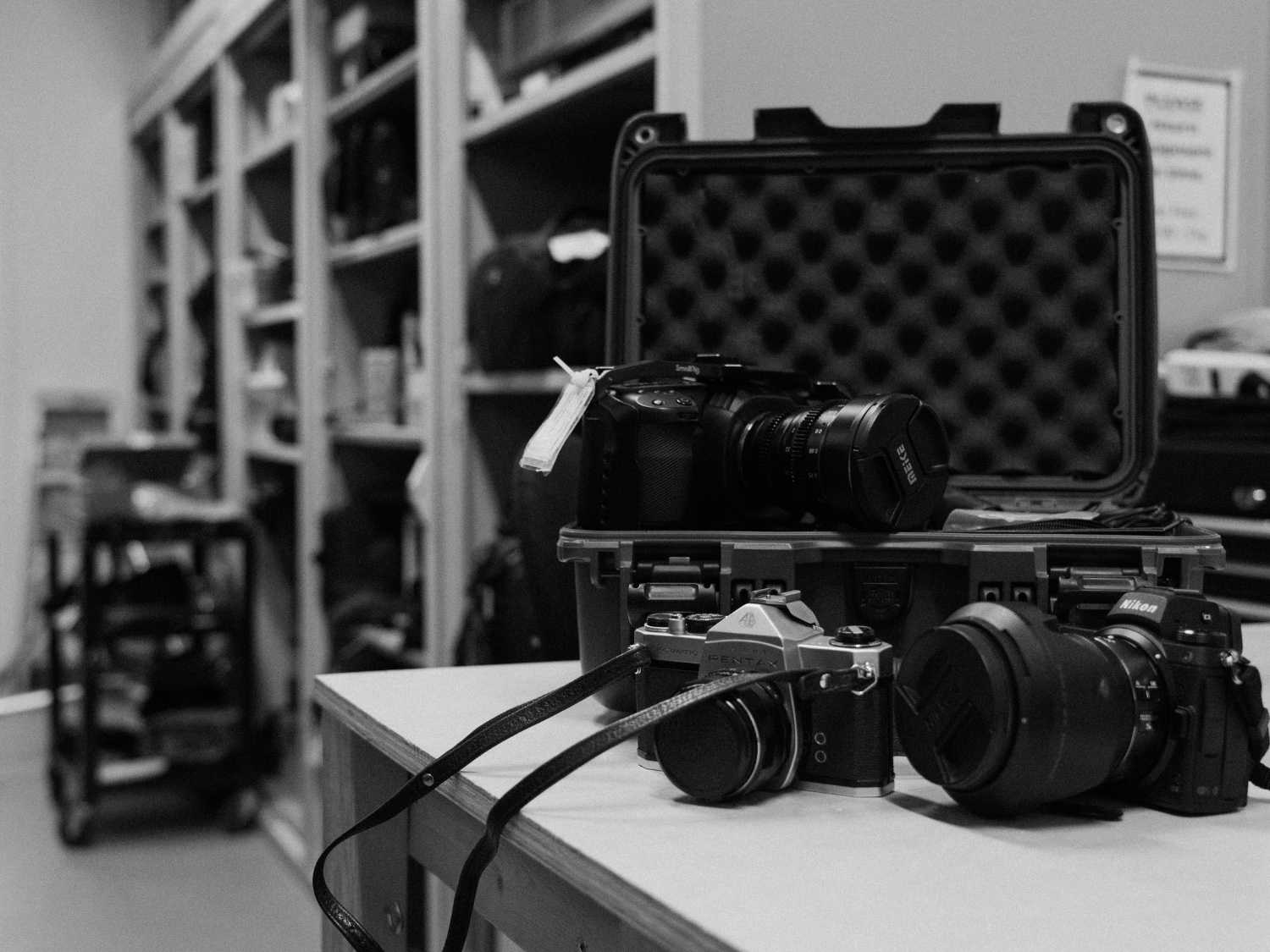
Films have immense value in the classroom. Whether it be theory or production, studying film opens our eyes to a generation’s taste in media. Not only that, the movie screen is also home to some of the most phenomenal forms of visual storytelling and the most relevant social critiques of our day.
Despite how much our lives have come to revolve around screens, the study of screen media is rarely seen in elementary and high school curricula. At most, movie adaptations of canonical novels like The Great Gatsby or maybe a Hitchcock film are all you may encounter in high school literature classes.
In post-secondary education, recent years have seen a proliferation of film studies programs. In general, however, universities have not allocated the same abundance of resources to film in the way that they have for other arts subjects like political science and psychology.
A quick search through UBC Okanagan’s courses listed on Workday and you will see a whopping result of nine film courses offered for the 2025–2026 Winter Session across both terms. Evidently, the small number of film courses leaves little room for a conversation about establishing a film major at this campus, but why don’t we have one in the first place?
With this question in mind, I interviewed Professor Denise Kenney from UBCO’s Faculty of Creative and Critical Studies. She is an experienced creator in theatre and filmmaking, and was instrumental in setting up UBCO’s Interdisciplinary Performance degree, which has now evolved into a minor in Theatre.
In the following conversation, Kenney and I discuss the barriers and benefits of providing film education at the Okanagan campus, as well as the alternative avenues available for students to get involved in film production.
Gabriela Chan: Hi Denise! Please introduce yourself, your teaching history at UBCO, and your involvement in the Film courses offered at this campus.
Denise Kenney: I started at UBCO in 2007 after working for 20 years as a professional theatre performer, creator, and director, as well as a writer, director and producer for narrative and documentary film and television. Since 2007, I have created and/or taught the following film courses: Introduction to Film (FILM 100), Acting for Stage and Screen (FILM 103), Narrative Film Production (FILM 303), Digital Documentary Production (FILM 371), Writing with Media (FILM 474).
Chan: There is no option to major in film at UBCO. Why is that?
Kenney: Film production courses require resources. To date I have not been able to successfully lobby for those resources to be dedicated to a film production major. We are looking at creating a film stream within our Bachelor of Media Studies degree. I am optimistic that this is going to happen.
Chan: That sounds like something we can look forward to. What do you think students can gain from studying film?
Kenney: Students will likely spend more time watching film, television and online digital content than doing most other things in their leisure time. Being literate in these forms improves both enjoyment in the process of viewing as well as empowerment in regards to digital ways of communicating. This is the kind of literacy that is absolutely necessary in order for us to navigate our personal and professional lives moving forward. I personally believe it to be profoundly important, regardless of one's major.
Chan: I love that you have pointed to the idea of digital literacy, and how it advances both personal enjoyment and interpersonal communication.
Here, let me take a small detour from the conversation between Kenney and I to unpack what we mean by being literate in digital content:
Films are loaded with meaning — I recall being in Kenney’s Narrative Film Production course and working on a short comedy about two friends playing UNO while being absolutely oblivious to the game’s rules. My classmate, Ana, and I found ourselves fixating on the smallest details such as how the playing cards were laid out on the desk and which instructions on the card box to show in-frame, because subtle visual cues like these combine to form a narrative.
That is a meaning-making process that takes place not only in film but also in commercials and social media content today. Learning to recognise and read these cues, to build on Kenney’s point, deepens our understanding of digital content.This not only helps us enjoy it more, but also makes us less susceptible to consumerist sales tactics that are often slipped into the content we watch on a daily basis.
The importance of digital literacy is part of why Kenney has been vying for more substantial film education at UBCO. Still, despite having less resources than the Vancouver campus and some other universities, the Okanagan campus is a unique environment for learning film production.
Kenney: Film and television is taking off in the Okanagan and productions are desperate for film crews and personnel of all sorts. This is a good time to get involved. Studying in the city where you want to actually work is a good idea, so it would be advantageous for a student to study here and begin to build connections with the local industry.
Chan: Yes, I can see that. The Okanagan has gradually established a local film industry in places like Enderby, Vernon, and here in Kelowna. The Okanagan Society of Independent Filmmaking has been hosting the annual Okanagan Screen Awards for three years; the Kelowna International Film Festival is also debuting later this year. Considering the local film scene, what advantage is there to taking a Film course at UBCO?
Kenney: I have worked in film and television in Vancouver and I know there is a lot going on there, but there is also a lot of competition and distractions. UBCO is more intimate and can offer more attention to students in terms of designing experiences that are aligned with their interests. Having said all this, it’s always up to the individual student to build their opportunities, no matter where they study. No program is going to “get you that job.”
Chan: Right. A film program will not magically secure a career in the industry, and one could more or less say the same for any line of work. If not by majoring in film, what other ways might our students gain the necessary skillset to get professionally involved in film production?
Kenney: First, there are other courses at UBCO related to filmmaking, such as the following:
Workshop in Creative Writing: Screenwriting (CRWR 250)
Intro to Digital Media I (VISA 106)
Intro to Digital Media II (VISA 108)
Studies in Photography (VISA 110)
Sound Art (VISA 206)
Photography I (VISA 244)
Photography II (VISA 256)
2D Animation (VISA 266)
Strategies in Digital Art: Visual Communication (VISA 268)
Strategies in Digital Art: Virtual Worlds (VISA 269)
Advanced Practice in Photography (VISA 362)
Advanced Practice in Media Arts (VISA 382)
Reading Screens (CULT 210/ENGL 215)
Cultural Industries (CULT 215)
Visual Anthropology and New Media (ANTH 252)
English-Canadian Screen Culture (CULT 305)
Studies in Cinema (FREN 327)
Digital Media and History: Documentary Filmmaking for Scholars and Activists (HIST 497)
Chan: Thank you for that list! I am sure our students will find it very helpful. What about resources outside of UBCO?
Kenney: Students need only do a google search for film training opportunities in the Okanagan and look at the Okanagan Film Commission website for information as well.
The opportunities are out there, but students need to take initiative to find them. The film industry is highly competitive and standards are high. Initiative and professionalism are very important qualities to have; production costs are high and people don’t want to take risks on personnel. In a way, the first hurdle to becoming involved is simply having the initiative to figure out how to become involved.
There are also many different kinds of engagement: post-production, locations, set decorating, props, gaming, computational arts… you name it. Students must be prepared to “pay their dues.” I always suggest that students make their own films, volunteer on projects, meet other emerging filmmakers, go to festivals, and get involved in any way they can. No amount of schooling is a substitute for experience. When I started out, there were only a few ways to get your independent film shot, edited, or seen. These days, production, post production and distribution has become so accessible that anybody can reach their audience if they work at it.
Chan: Finally, to wrap up this interview, what do you enjoy most about teaching film?
Kenney: I love teaching Film. Teaching Film courses puts students in direct conversations with the artists they love and helps them find their voices as artists themselves.
I am not teaching students for the existing film/TV/online world, but rather for the film/TV/online world I perhaps can’t imagine yet. I believe the next generation of artists (students) will move these art forms forward. That requires imagination, creativity, and listening to emerging aesthetics, perspectives and ideas.
Teaching film is always a process of reciprocal learning. It is difficult to keep up with such a quickly evolving form, and I often find my students are on the pulse of something I hadn’t considered. I know I have a lot to teach them, but they also keep me on my toes. That’s fun.
Kenney’s final comments emphasise the value of teaching film. It fosters creativity and imagination, qualities that are becoming increasingly precious as we learn to co-exist with generative AI technologies. If we hope to keep seeing new and interesting stories on screen, not formulaic variations of the same one, then the ability to recognise narrative techniques and to also develop your own is crucial. Additionally, the collaboration and exchange of ideas involved in filmmaking is exciting for both the students and the instructor.
Having a dedicated program for film, more equipment, and experienced instructors would make the aforementioned learning experience more accessible and straightforward for students. Hence, the potential for a film stream in UBCO’s Bachelor of Media Studies program is promising, but even now, one can take the initiative to learn to read screens and make movies here in the Okanagan.
Filmmaking is such a hands-on activity and the industry is so reliant on building connections that access to film schooling, while helpful, is not the end-all-be-all for aspiring filmmakers. The most important step, like Kenney says, is to make something. Remain creative, share your projects with the communities around you, and surely, one day your name will appear as the credits roll for a piece of work you were proud to bring to life.



.png)

