
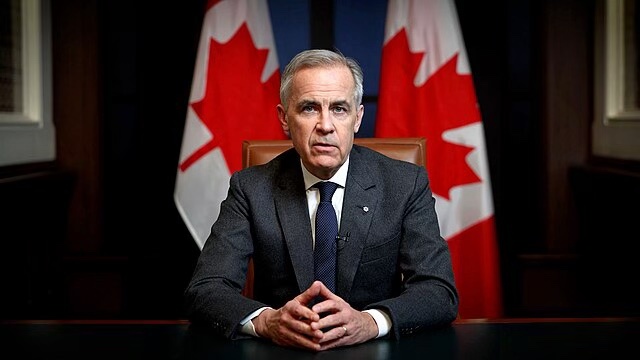
As Carney's premiership continues, it has become clear that no prime minister can govern and attain any degree of popularity without first announcing an agenda, fulfilling that agenda, and doing so in a manner popular with voters. For Carney, that should be a particularly easy task; most of his voters backed him in the name of simply opposing the United States and preventing any undue influence from seeping into Canada. The sole task to keep those voters happy is to at least seem as though he is opposing the influence of President Trump, and Carney's speech at Davos seems to have irreparably done so. Now, with his anti-Americanist credentials solidified and poll numbers soaring, Carney has turned to one of his own personal policy priorities: the removal of trade barriers between provinces and, fittingly, between America and Canada.
To that end, the Premiers of Canada assembled on January 29, 2026 in Ottawa with PM Carney for a First Ministers’ conference, and began formally discussing opportunities for international trade through the establishment of the "Team Canada Trade Hub", a means of coordinating trade between provinces. That meeting created three opportunities for political gain for Carney beyond interprovincial trade coordination: the first, a Heated Rivalry reference on the relationship between Premiers Wab Kinew of Manitoba and Doug Ford of Ontario; the second, an opportunity for Carney to appear as a decisive leader before the premiers of the country, speaking with authority on an issue he is well-versed in; and the third, a new crisis generated without his own public intervention to bring it to the limelight.
B.C. Premier David Eby, speaking at the conference, brought up a report featured in the Financial Times explaining that Albertan separatists had met with members of the Trump administration, describing it as "treason." The report was already a bombshell, and Premier Eby’s denunciation brought further attention to the matter. What followed was an explosion of discourse surrounding the incident referenced, and the presence of Albertan separatists in the contemporary political climate of Canada. At present, much of Albertan separatism's support is based out of the Republican Party of Alberta (RPA), which is exactly what it sounds like: a political party which supports a referendum on Albertan independence. Presently polling at 1-2% of the vote, the RPA is broadly ridiculed, though representative of a well-funded selection of interest groups in the state.
Chief among those groups is the "Alberta Prosperity Project," whose leaders were the ones known to have met with U.S. State Department officials at least three times. While the topic of discussion is officially unknown, most people feel confident enough to guess that these discussions had to do with the separatists taking cues or cash from Washington (which, coincidentally, is where the meetings were all held).
Little would come in terms of consequences for those responsible for meeting members of the State Department, despite Premier Eby's description of the acts as being treasonous. What has had considerable staying power, however, has been the consequences of one of the myriad topics also raised in the Premiers meeting: the Canada-United States-Mexico Trade Agreement (CUSMA).
CUSMA is up for renegotiation between all constituent members, a particularly tense topic for Canada and the U.S. given Canada's recent pivot to trading with China. Accordingly, the U.S. is provided with the choice of either attempting to revive their relationship with Canada or commit entirely to kissing it goodbye. On the one hand, this deal entails lowering trade deals and tariffs with each other — not a total likelihood with Trump.
On the other hand, however, Trump has been known to still treat Canada with some degree of exclusive respect which he has not afforded to others. Consider that in recent developments of the CUSMA negotiations, despite Trump's recent announcement of a global 10% tariff on all goods against all countries, he is keeping a carveout for CUSMA to maintain high trade, demonstrating at least some degree of interest in maintaining preferential treatment.
In the aftermath of the First Ministers’ conference in Ottawa, however, it seems as though all participants of the meeting profited in some way politically. Eby was able to seem like a fighter against divisive forces in Canada, Carney was able to seem like a coherent leader among the provinces, working with them to lower trade barriers and building up the groundwork for further negotiations concerning CUSMA and beyond. Without much political cost, then, both figures have been able to seem as though they're standing taller than otherwise able, as well as standing as "Anti-American figures" without having to lift a finger.


.png)

